For Colleges & Universities

Your Campus Is Already Dealing With This

Sextortion, deepfake abuse, and leaked images don't stop at the campus gates — they move through group chats, dorms, and DMs faster than any single office can track alone. We help students get their images down and get support, and we help the people around them know what to do when it happens. Free. Confidential. Built for how this actually shows up on campus.

The stories below are composite examples — built from patterns we see and patterns documented in public reporting, not the story of any one real person. We tell them this way on purpose: to protect the privacy of everyone whose real cases informed them, while still being honest about how this actually shows up on a campus.

  • Maya's Story

    Maya matched with someone on a dating app during her sophomore year. They talked for weeks before it turned romantic, then sexual. The photos she sent felt like part of a real relationship — until he sent one back with a price on it: pay, or her parents and her sorority group chat would see everything.

    She didn't pay. She also didn't tell anyone for three days, because she was sure she'd caused this herself.

    Composite example, reflecting patterns documented in FBI and NCMEC sextortion data and DIF's own casework.

  • Ethan's Story

    Ethan got a message from a woman he'd never met, complimenting a photo from his Instagram. The conversation moved fast. So did what came next: an image that didn't exist until an AI tool built it out of his own photo, followed by a demand for $500 sent to an account he didn't recognize — or his professors and his team group chat would get a copy.

    Men are targeted this way more often than most people assume, and report it far less. Ethan almost didn't.

    Composite example. Financial sextortion disproportionately targets young men, and is significantly underreported due to stigma — this reflects that documented pattern, not one individual's case.

  • Sofia's Story

    Sofia and her boyfriend of two years broke up in March. In April, a friend sent her a screenshot: photos she'd only ever sent him, posted to a private forum with her university and her real name attached.

    She hadn't broken any rule, told anyone anything they didn't already have consensually, or done anything but trust someone she loved. None of that stopped it from spreading through people who knew her.

    Composite example, reflecting the pattern most commonly reported to DIF and documented broadly as non-consensual intimate imagery (NCII) shared by a former partner.

Whatever it's called, you can get help — and it's never your fault.

10%
of college students experience image-based sexual abuse during their undergraduate years
1 in 5
teens surveyed have experienced sextortion
1 in 17
have had a deepfake nude made of them without their consent

Sources: Wake Forest University Safe Office, citing Branch, Eaton & Ruvalcaba (2017) and Henry, McGlynn, Flynn, Johnson, Powell & Scott (2024); Thorn, “Sexual Extortion & Young People” and “Deepfake Nudes & Young People” (2025 surveys of young people ages 13–20).

For Students

If This Is Happening to You Right Now

Maybe someone shared images of you without your permission. Maybe a deepfake of you is circulating in a group chat. Maybe someone's threatening to post something unless you pay them or send more. Whatever it is, you don't need to have it figured out before you reach out to us.

You do not need to file a Title IX complaint, talk to campus police, or tell anyone at your school to get our help. You can do all of that later, or never — that's your call, not ours. What we can do right now: help you get images removed from wherever they are, walk you through your options, and connect you with people trained to support you. At no cost, and without your name going anywhere you haven't agreed to.

This might be for you if:

  • Images shared without consent

    Someone shared or threatened to share intimate images or video of you without your consent
  • A deepfake of you

    Someone made, or is threatening to make, a deepfake or AI-altered image of you
  • Pressure or blackmail

    You're being pressured or blackmailed — for money, more images, or contact — commonly called sextortion
  • You don't know where to start

    You don't know how something spread, or how many places it's been posted, and you don't know where to start

Leadership Opportunity

Become an Aster Ellis Campus Advocate

A movement to end online sexual violence starts on your campus. We are looking for the leaders ready to guide the way.
Apply to the Program

You can submit your case through our online form any time, day or night. Our advocates respond Monday–Thursday, 9am–5pm ET, and we'll get back to you as soon as we're back if you reach out outside those hours. If you're in immediate danger, call 911 (U.S.) or your local emergency number.

You may also want to read survivor stories from students and others who've been through this or our community's own writing on healing and takedowns. If you'd rather understand what's going on first, we built a short reading list for students.

Leadership

Become an Aster Ellis Campus Advocate

A movement to end online sexual violence starts on your campus. We are looking for the leaders ready to guide the way.

Did you know that 1 in 10 college students will experience image-based sexual abuse or online sexual violence during their undergraduate years? Despite how common it is, most students suffer in silence, unsure of their rights, terrified of exposure, and unaware that help is available.

We are changing that, and we need you with us.

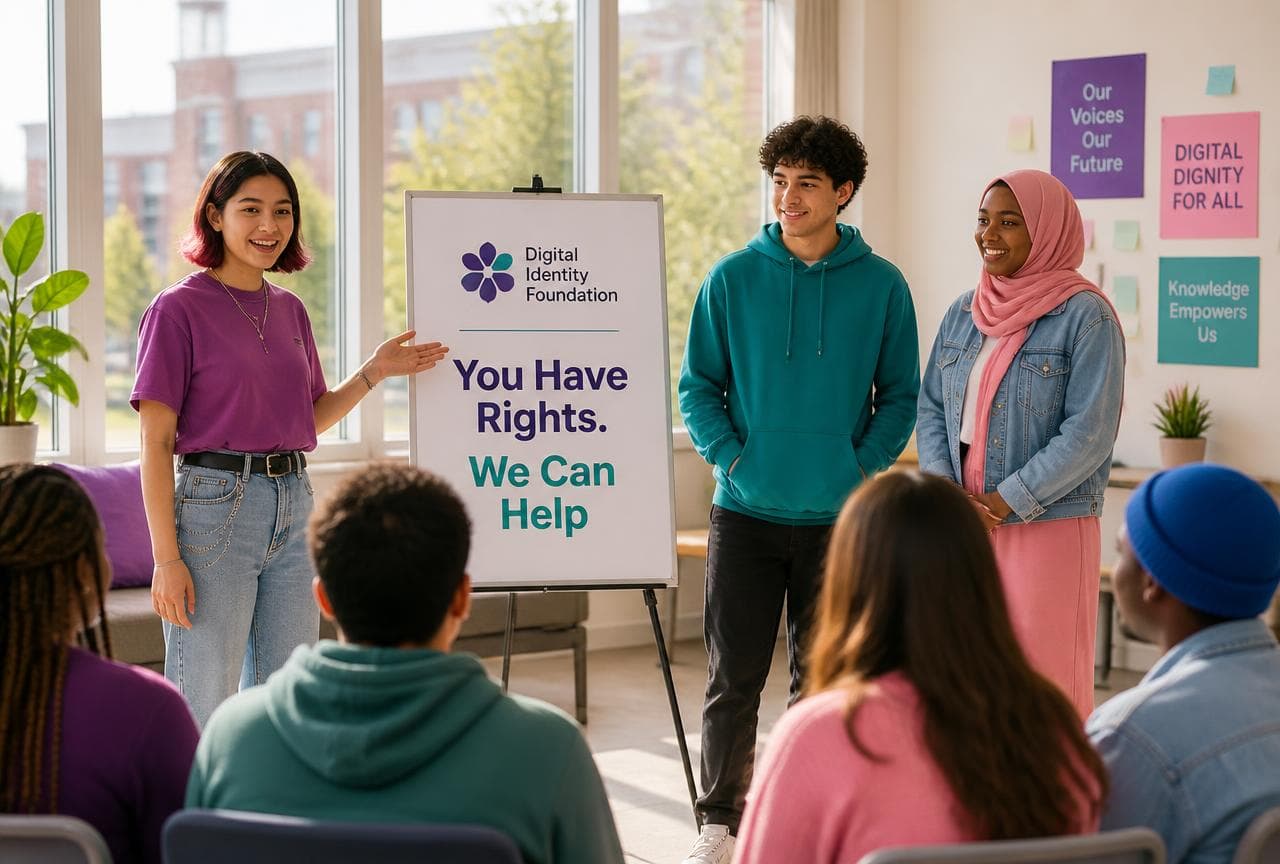
  • Three diverse college students presenting a Digital Identity Foundation workshop on campus with a sign that reads You Have Rights. We Can Help.
    Campus advocates lead workshops that help peers understand their rights and options.
  • A campus advocate meets professionally with a university wellness staff member in a bright, supportive office.
    Advocates work alongside campus wellness and Title IX offices to bridge the gap for survivors.

The Digital Identity Foundation is launching the Aster Ellis Campus Advocate Program, an exclusive leadership and advocacy initiative for college students who are fiercely dedicated to making their campuses safer. We are looking for student leaders who want to step up, get trained, and become the trusted, on-the-ground guides for survivors navigating the devastating impact of sextortion, deepfakes, and nonconsensual image sharing.

As an Aster Ellis Advocate, you won't just be raising awareness. You will be actively changing the culture and safety infrastructure of your university.

What You Will Do

  1. Be the Guide

    Serve as a trained, trusted peer resource for survivors on your campus. You will help students understand their rights under the federal Take It Down Act and connect them to our free, confidential content removal and legal support services.
  2. Educate & Empower

    Host workshops and lead campaigns to teach your student body exactly what image-based sexual abuse is and how to fight it.
  3. Bridge the Gap

    Work directly with your university's Title IX office, campus police, and wellness centers to ensure their policies and responses actually protect and support survivors of digital crimes.
  4. Build the Community

    Create a campus environment where survivors know they are never alone and that justice and healing are possible.

The Training

Step Into Your Power

You do not need prior experience in crisis response—we will teach you everything you need to know.

In mid-September, all accepted advocates will attend an immersive, virtual training led directly by me, Andrea Powell, Executive Director and co-founder of The Digital Identity Foundation. To protect the privacy and safety of our cohort—as many of our student leaders are survivors themselves—we do not publicly post the exact dates or registration links for these sessions. Once your application is accepted, we will coordinate securely with you to finalize your schedule.

Drawing on 20 years of front-line advocacy alongside survivors, I will equip you with the exact tools, language, and systemic knowledge you need to safely and effectively support your peers. You will leave this training ready to lead, advocate, and transform your campus.

Join the Movement

If you are ready to stand with survivors and ensure no one on your campus is left behind, we want you on our team. Apply below to join our inaugural cohort.

Are you available to attend a 2-hour virtual training session in mid-September?

For Campus Offices

If You Support Students — Title IX, CAPS, Res Life, and Beyond

Image-based sexual abuse moves faster than most campus policies were built to handle, and it rarely arrives labeled clearly as a Title IX matter, a mental health crisis, or a conduct issue — usually it's some combination of all three, and it lands on whichever office a student trusts enough to tell first. We're built to work alongside whichever office that is.

We're not a replacement for your Title IX process, your CAPS team, or your public safety office. We're a free, confidential layer that can move on image removal immediately, without waiting on any internal process, while your existing systems do what they're built to do.

  1. Trainings, built around your team

    We offer trainings tailored to your office — a session for Title IX staff, a workshop for resident assistants, an orientation module for incoming students, or something built specifically around what your campus is seeing. Every training looks different because every campus is different. Tell us what your team needs, and we'll build toward it.

    Read our guide: Image-Based Sexual Abuse and Title IX →

  2. Referring a student

    If a student comes to you, you can point them directly to thedigitalidentityfoundation.org/campuses or connect them with us yourself. With the student's consent, we can coordinate with your office on next steps — but we will never share what a student tells us without their permission, and a student never has to go through your office to reach us, or vice versa.

A note on scope

This isn't legal guidance on your school's Title IX or Clery Act obligations — loop in your legal counsel for that. We're here for the part a specialized team can move fastest on: getting images down and supporting the student through it.

Partnership

Who we typically work alongside

  • Title IX Coordinators & Offices
  • Counseling & Psychological Services (CAPS)
  • Campus Health Services
  • Dean of Students / Student Conduct
  • Campus Public Safety & Police
  • Residence Life & Resident Assistants
  • Greek Life Advisors
  • LGBTQ+ Resource Centers
  • International Student Services
  • Multicultural & Student Affairs Centers

Questions

Frequently Asked Questions

What is sextortion?
Sextortion is when someone threatens to share — or fabricate — sexual images or video of you unless you pay them, send more images, or do something else they're demanding. It's a crime, and it's not your fault, whether or not you sent an image first.
What is a deepfake?
A deepfake is a fabricated photo or video, usually made with AI, that makes it look like someone did or said something they never did — including sexually explicit content the person never created or agreed to. You don't have to have taken a real photo for a deepfake to be made of you.
What is revenge porn / NCII?
“Revenge porn” — more accurately called non-consensual intimate imagery (NCII) or image-based sexual abuse — is any sharing of intimate images or video without the consent of the person shown, regardless of the sharer's motive or relationship to that person.
Do I have to report to my school or the police to get help?
No. You can get help from us regardless of whether you ever file anything with your school, the police, or anyone else. Reporting is always your choice.
Is this free?
Yes — for students, and for campus offices requesting trainings.

Print & Share

Download our campus flier

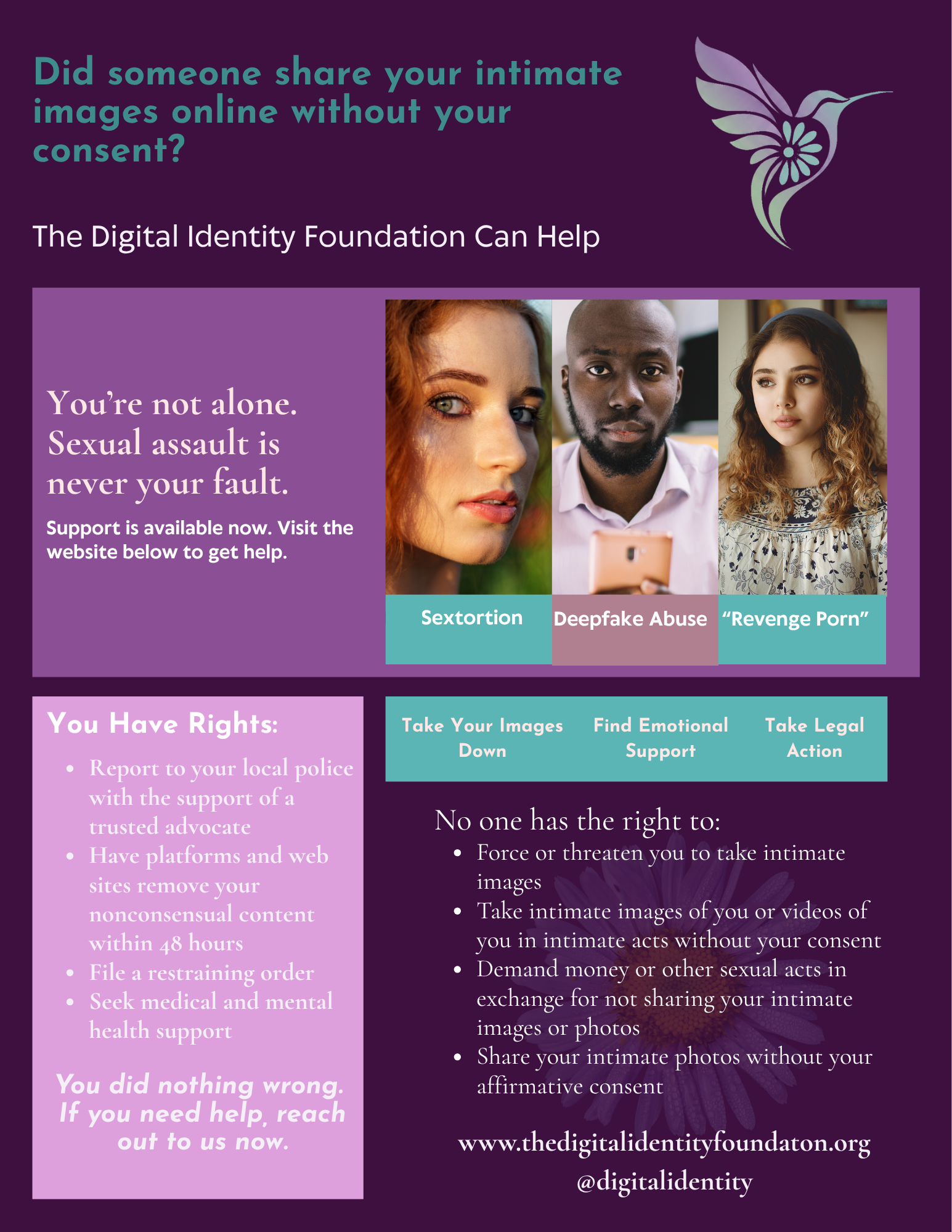
A one-page flier students and staff can print and post — in residence halls, health centers, Title IX offices, Greek houses, and student unions. It covers sextortion, deepfake abuse, and non-consensual intimate imagery, what your rights are, and how to reach us.

Watch

See the training in action

A 98-second preview of our free training, from a real session with co-founder Andrea Powell.

You Don't Have to Figure This Out Alone

Stay Connected

Stay Updated on Survivor Stories and Advocacy

Get notified when we publish new stories and share advocacy updates. A couple emails a month, easy to unsubscribe.

Emails come from the Digital Identity Foundation with a neutral subject line.